Introduction
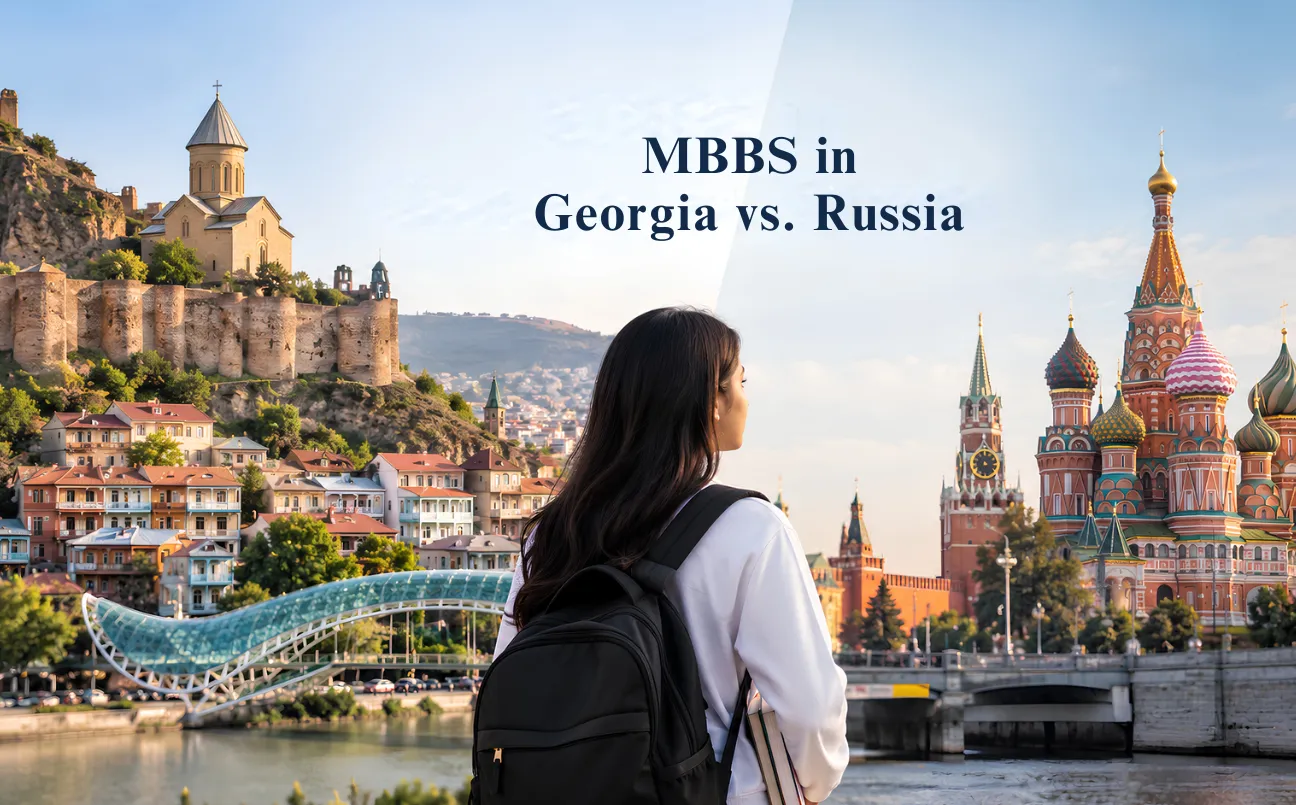
For years, Russia was one of the first countries Indian students considered when looking for an affordable medical degree abroad. But today, the focus of the conversation is changing. In 2026, more students are exploring opportunities that expand beyond conventional choices and are also asking a different question: Which country provides a more practical and comfortable path to becoming a doctor?
This is where Georgia is gaining attention.
With English-medium programs, internationally recognized universities, a growing number of medical schools, and a relatively accessible European environment, Georgia has become a serious option for Indian students planning to pursue medicine abroad.
But is Georgia actually a much better choice than Russia?
The answer to this question depends on what you value the most. A closer look at MBBS in Georgia vs. Russia shows why Georgia is turning out to be an appealing choice to students who want English-medium education, a modern academic environment, and a smoother international student experience.
MBBS in Georgia vs. Russia: What Has Changed in 2026?
Therefore, students should also calculate the total cost of the entire degree and not compare countries using the first tuition figure they see online.
Both countries have well-established medical education systems that attract thousands of international students every year.
Well, the biggest shift is that the students are no longer evaluating medical education only on the basis of tuition fees. They are also considering the medium of instruction, clinical training, university infrastructure, international exposure, student support, and future licensing needs.
These are some of the vital parameters that make the comparison more practical than simply asking which country is cheaper.
| Factor | Georgia | Russia |
|---|---|---|
| Medical programs for international students | Widely available | Widely available |
| English-medium programs | Available at several universities | Available at selected universities |
| European academic environment | Yes | No |
| International student population | Strong | Strong |
| Tuition fees | Varies by university | Varies by university |
| Climate | Generally milder | Often significantly colder |
| Major medical education hubs | Tbilisi, Batumi, Kutaisi | Moscow, St. Petersburg, Kazan, and others |
| Key consideration for Indian students | University and program compliance | University and program compliance |
Here, the important point that you should remember is that neither country should be chosen only on the basis of its location or the advertised fee. Indian students should also verify whether the specific medical program and university are able to meet the current National Medical Commission requirements.
1. English-Medium Medical Education is a Major Advantage
One of the biggest reasons why students choose to study medicine in Georgia is the availability of English-taught medical programs.
This can make the academic transition easier for Indian students, especially in subjects such as anatomy, physiology, pathology, pharmacology, and clinical medicine.
The official Education in Georgia program directory currently lists multiple English-medium medical programs. For instance, courses at BAU International University Batumi, New Vision University, Tbilisi State Medical University, University of Georgia, European University, etc., are listed as English-taught medical programs.
This does not mean that the students should completely avoid learning the new language. During clinical training, basic Georgian can be useful when communicating with patients.
2. Georgia Provides a Growing Choice of Medical Universities
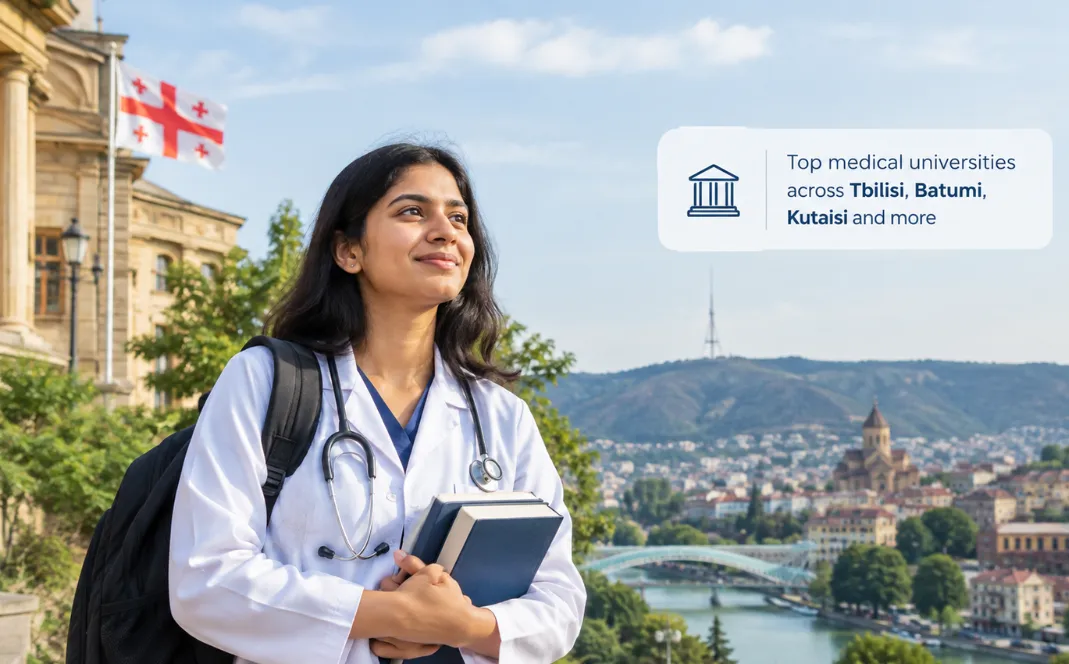
Another factor influencing MBBS in Georgia vs. Russia is the range of universities available for international students.
Georgia has developed a significant selection of medical programs for international students in some of the best and leading medical universities across cities like Tbilisi, Batumi, Kutaisi, and other locations. Students can also explore the top medical universities in Georgia to compare their academic programmes, locations, fees, and facilities before making a decision.
Some of the important examples consist of the following:
- Tbilisi State Medical University
- Illia State University
- University of Georgia
- European University
- BAU International University Batumi
- Alte University
- New Vision University
As per the official programme directory, the annual tuition fees range from $4,000 to $8,000, but the fees can vary significantly from one institution to another.
3. The Academic Environment Feels More International
For an Indian student leaving home for the first time, the academic environment matters almost as much as the degree itself.
Georgia’s higher education sector has become quite open to foreign students, with some universities providing courses in English and attracting students from various countries.
Studying medicine in Georgia also provides international students with an opportunity to learn in a diverse and multicultural environment. Communicating with classmates from different countries can not only broaden their perspective but also help them adapt to different cultures and healthcare settings.
This international exposure can be a value addition for students who plan to pursue postgraduate education, licensing examinations, research, and medical careers abroad in the future. But the level of international exposure can vary significantly from one university to another, so students should be able to assess each institution based on its student community, academic environment, clinical training, and support services.
4. The European Location Adds to Georgia’s Appeal
Georgia is nestled at the intersection of Europe and Asia, which also gives it a different character from Russia.
For Indian students, this can mean exposure to a more European-centric academic and cultural environment while still studying in a country where medical education can be comparatively accessible.
Cities like Tbilisi and Batumi also provide a compact student lifestyle with universities, accommodation, restaurants, public transport, and everyday services accessible within the city.
5. Cost Still Matters, But It Should Not Be the Only Deciding Factor
Affordability remains one of the main reasons Indian students consider medical education abroad. However, looking only at tuition can create problems. Students should also compare the overall expenses and long-term value of studying abroad with their options in India. A detailed MBBS in India vs MBBS abroad comparison can help students understand the differences in costs, education, and other important factors.
A student’s actual budget should also include the following:
- Tuition fees
- Accommodation
- Food
- Transportation
- Health and insurance
- Visa and residency-related expenses
- Study materials
- Travel between India and Georgia
- Personal expenses
Well, as per the official Education in Georgia directory, medical tuition can vary significantly from one university to another. Current listings include programmes around $4,000, $5,000, $6,000, $6,500, $7,000, and $8,000 per year.
Therefore, students should also calculate the total cost of the entire degree and not compare countries using the first tuition figure they see online.
6. Scholarships Can Make Georgia More Accessible
Financial support is another area that the students should carefully assess before finalizing a university.
MBBS scholarships in Georgia can vary based on the university, academic performance, admission cycle, and scholarship policy. Not every medical university will provide the same funding structure, and students should confirm eligibility directly with the institution.
Scholarships can be merit-based, institution-specific, and even offered through academic initiatives.
Rather than assuming that a university will provide a full scholarship, students should check for the following:
- Who is eligible?
- Does the scholarship apply to the medical programs?
- Is it available to international students?
- Is it renewable every year?
- Does it cover tuition only or other expenses as well?
- What level of academic performance is needed to retain it?
This approach will provide students with a realistic picture of their financial problems.
7. Clinical Training Should Be a Top Priority

A medical degree is not just about lectures and examinations. Clinical exposure is important too.
This is where students should also look beyond country-level comparisons.
Whenever you are evaluating MBBS in Georgia vs. Russia, you should also check for the university’s affiliated hospitals, clinical rotations, patient exposure, teaching facilities, and the structure of practical training.
Moreover, Indian students planning to return to India should also understand the NMC’s current foreign medical graduate requirements.
The better approach is to verify the applicable NMC requirements before selecting a university and programme; some of the criteria that are to be met include a minimum of 54 months of study in medicine, a 12-month internship program within the same foreign medical school, use of English as the language of instruction, specified subjects, and many more.
Students have also been advised by the NMC to ensure course duration, curriculum, clinical experience, and internships before studying overseas. This makes due diligence at the university level necessary.
8. What About FMGE and NExT?
This is perhaps one of the most important facts for Indian students to know.
A medical education from abroad does not necessarily ensure medical registration in India.
The system of regulation may be subject to change, and at present, the National Medical Commission site has the rules of the Foreign Medical Graduate Licentiate Regulations and the National Exit Test Regulations listed among the regulations.
The students thus have to monitor the exam and registration requirements relevant to their batch.
The right strategy is easy, and that is to pick the university that adheres to regulations first and then prepare for the license according to those requirements.
Georgia or Russia: Which One Should the Indian Students Choose?

There is no one-size-fits-all solution.
Russia continues to have established medical universities and remains a valid option for students who carefully evaluate their institution and program.
But Georgia provides several benefits that are particularly attractive in the present-day scenario, especially for the Indian applicants: a broad selection of English-medium medical programs, an international academic environment, a European location, and multiple university options.
-
If your priority is
What to consider
-
English-medium education
Calculate complete 5–6-year expenses.
-
International environment
Check the university’s international student profile.
-
Clinical exposure
Review affiliated hospitals and rotations.
-
Scholarships
Check university-specific MBBS scholarships in Georgia.
-
Returning to India
Verify current NMC requirements.
-
Comfortable student life
Compare city, climate, accommodation, and support.
-
Future global opportunities
Examine curriculum and international exposure.
Why is Georgia Getting More Attention in 2026?
The increased attraction towards Georgia is part of a bigger trend in how Indian students perceive overseas medical education. Students today are more informed and spend considerable time researching their options before making a decision. Instead of choosing a country only on the basis of affordability or popularity, they increasingly compare universities, curriculum, affiliated hospitals, teaching methods, licensing prerequisites, student reviews, and post-graduation prospects.
This shift towards research-driven decision-making has made Georgia an option worth considering for students looking at medical education abroad. The country offers various medical programmes taught in English, which can make it easier for international students to follow their academic coursework. Students can also compare different universities, locations, fee structures, clinical training arrangements, and student support services before selecting a programme that matches their priorities.
Another factor behind Georgia’s growing visibility is its international student presence. The country’s official higher education statistics portal tracks foreign students by programme and citizenship, reflecting the importance of international education within the country’s higher education sector. For Indian students, this growing international environment can also provide an opportunity to study alongside students from different countries and experience a more diverse academic setting.
At the same time, increasing popularity should never replace due diligence. A destination becoming popular does not automatically mean that every university or medical programme will meet an individual student’s requirements. The quality, structure, clinical exposure, teaching language, and regulatory compliance can differ between universities.
Before paying an admission fee, students should verify the university, programme format, course duration, mode of teaching, curriculum, affiliated hospitals, clinical experience, internship arrangements, total cost, and latest NMC requirements applicable to their admission batch. They should also confirm the information directly through reliable and official sources wherever possible.
For Indian students, the better approach is therefore not simply to ask “Why is Georgia popular?”, but to ask “Does this particular university and programme meet my academic, financial, clinical, and future licensing requirements?” This approach can help students make a more informed decision instead of choosing a medical university based solely on current popularity.
Wrapping Up
The discussion around MBBS in Georgia vs. Russia is not simply about choosing the “best” country. The right choice depends on how well each option balances quality of education, total cost, clinical training, international exposure, student life and regulatory requirements.
For Indian students considering MBBS in Georgia, the country offers an increasingly attractive range of English-medium medical programmes and an international academic environment. However, students should evaluate each medical university individually rather than relying on broad country-level claims. The university’s curriculum, clinical training, course structure, teaching language, costs and applicable NMC requirements can make a significant difference to the overall experience.
If Georgia is on your list for 2026, start by comparing universities, calculating the complete cost of education and living expenses, reviewing clinical and internship arrangements, and understanding the latest NMC requirements applicable to your admission batch. A well-researched decision can help you choose a programme that fits both your immediate academic goals and your long-term plans to practise medicine in India or pursue opportunities abroad.