

Introduction
Completing an MBBS in Georgia is a major milestone, but for Indian medical graduates, the journey does not end with receiving the degree. The next challenge is preparing for the licensing exam that will allow them to move a step closer to practicing medicine in India.
For many students, the FMGE after MBBS in Georgia can feel overwhelming at first. As there are multiple subjects to revise, thousands of MCQs to practice, and limited time to bring years of medical learning back into focus. However, the good news is that the preparation becomes much more manageable when it follows a clear study plan rather than random revision.
At the same time, discussions around NExT for Indian students have added another layer of confusion. As of August 2026, FMGE continues to be conducted for all eligible foreign medical graduates, while NExT has not yet replaced it. So, here the smartest approach will be to prepare for the current FMGE pattern while building strong clinical concepts that can easily support future NExT exam preparation.
This blog breaks down a practical study plan to help you revise smarter, practice effectively, manage weak subjects, and approach the exam with greater confidence.
FMGE or NExT: What Should You Prepare For?
Before planning for the FMGE after MBBS in Georgia, you should try to understand the current situation.
Since there is a possibility that the exam framework might change in the future, students should regularly check the official NMC and NBEMS updates.
The NMC had introduced the National Exit Test regulations in 2023, but the implementation of NExT was later deferred. For now, eligible foreign medical graduates are supposed to prepare for the FMGE until an official transition to NExT is announced.
| Route | Current Position | Best Preparation Focus |
|---|---|---|
| FMGE | Currently continues for eligible foreign medical graduates. | Subject revision, MCQs, recall, integration, and exam practice. |
| NExT | Planned national exit/licensure framework, but not yet the operative replacement for FMGE. | Concepts, clinical reasoning, and application. |
| Best approach | Prepare for FMGE and track official updates. | Build knowledge useful in either format. |
Since there is a possibility that the exam framework might change in the future, students should regularly check the official NMC and NBEMS updates.
The NMC had introduced the National Exit Test regulations in 2023, but the implementation of NExT was later deferred. For now, eligible foreign medical graduates are supposed to prepare for the FMGE until an official transition to NExT is announced.
Since there is a possibility that the exam framework might change in the future, students should regularly check the official NMC and NBEMS updates.
Why Start Preparation Before Graduation?

Students often focus heavily on their final-year subjects and may lose touch with the concepts they studied earlier in medical school. For students comparing MBBS abroad vs MBBS in India, understanding the differences in curriculum, clinical exposure, and future licensing requirements can help them make a more informed decision.
Students often focus heavily on their final-year subjects and may lose touch with concepts studied earlier in medical school. That is why it makes sense to start the FMGE preparation during MBBS in Georgia, rather than waiting until graduation to cover the complete syllabus.
This does not mean following a full-time exam schedule along with regular classes. Rather, students can gradually revise important concepts and connect them with clinical cases they study. For instance, a case discussed in medicine can also help revise related concepts from pathology, pharmacology, and microbiology. This makes it easier for students to manage revision for the FMGE.
A Practical Six-Month Study Plan
Students planning to take the FMGE after MBBS in Georgia will find that a six-month strategy works best when each phase has a defined purpose.
| Month | Main Goal | What to Do |
|---|---|---|
| 1 | Build the base | Revise major subjects, create short notes, and begin daily MCQs. |
| 2 | Finish first revision | Cover remaining subjects and revisit weak concepts. |
| 3 | Integrate subjects | Link pathology, pharmacology, medicine, surgery, and clinical cases. |
| 4 | Increase question-practice | Solve mixed MCQs and timed subject tests. |
| 5 | Second revision | Focus on incorrect questions, images, formulas, and volatile facts. |
| 6 | Exam simulation | Take full-length mocks, analyze errors, and revise repeatedly. |
Well, for FMGE after MBBS in Georgia, the first revision should focus on covering the syllabus clearly and not mastering every detail at once. You should avoid spending too much time on lengthy notes, as regular revision and practice are more important.
1. Months 1-2: Build a Reliable Foundation
You should start with subjects that serve as the foundation for other subjects. For instance, medicine becomes easier when physiology, pathology, pharmacology, and microbiology are reasonably clear.
Moreover, you should use one primary source per subject. Constantly switching between videos, notes, apps, and textbooks can reduce retention and also lead to chaos.
For students planning to study medicine in Georgia, it is also worth exploring whether Indian students can get MBBS scholarships in Georgia and what funding opportunities may be available before beginning their medical education.
For every topic: review the concept properly, recall the key points without looking, solve 20-50 related MCQs, review every wrong answer, and add useful mistakes to a short revision notebook.
This gently turns preparation for the FMGE after MBBS in Georgia into active learning.
2. Months 3-4: Move From Reading to Application
By the third month, MCQs should form a major chunk of your study time. You should not wait until you “know everything.”
Clinical questions will test whether you can identify patterns, separate similar diagnoses, and choose the next best step. This also contributes towards your preparation for the NExT exam.
Whenever you are reviewing a question, you should ask yourself the following:
- Why was my answer wrong?
- Was the problem a knowledge gap or a reading mistake?
- Would I answer a similar question correctly tomorrow?
You should use mixed question blocks too. A jaundice case, for instance, may involve anatomy, pathology, medicine, surgery, pharmacology, and radiology.
3. Moths 5-6: Revise, Test, and Correct
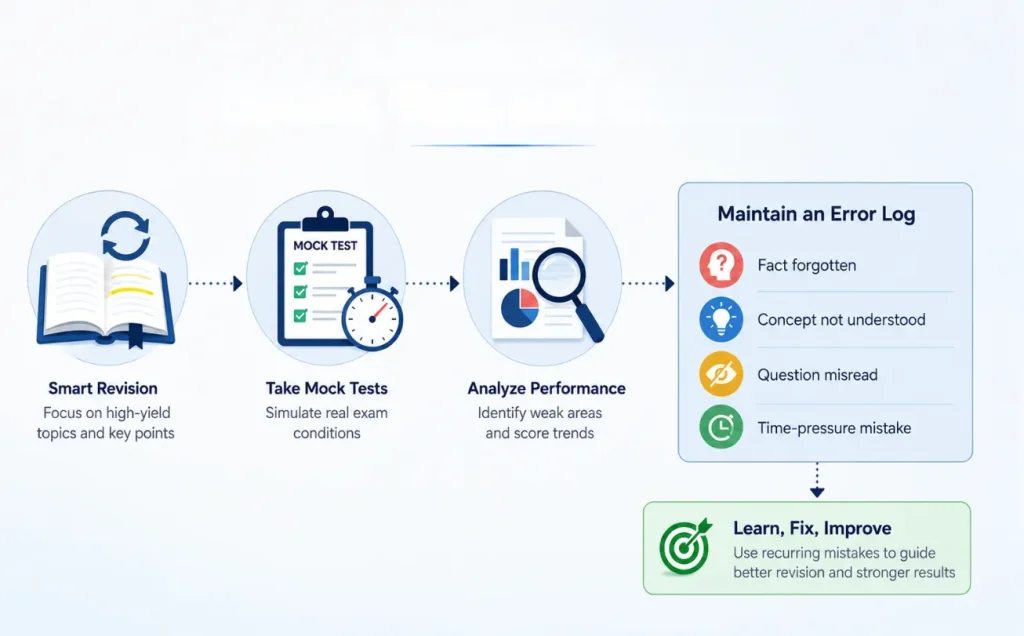
The final phase for the preparation of the FMGE after MBBS in Georgia should focus on retrieval rather than the material.
As per the NBEMS FMGE 2023 country and institute-wise performance report, 10,261 of 61,616 candidates passed, with an overall pass percentage of 16.65%. It does not predict individual results, but it clearly shows why structured preparation matters.
So, you should take a full-length mock test under real exam-like conditions and analyze it. A mock test will change the course of your preparation and what you choose to study next.
You should create a simple error log:
- Fact forgotten
- Concept not understood
- Question misread
- Time-pressure mistake
After several mock tests, you should make use of the recurring mistakes pattern to see where you are facing problems, and this will pave the way for a better revision.
What Should a Daily Study Schedule Look Like?
For FMGE after MBBS in Georgia, a good schedule should be repeatable.
| Time Block | Activity |
|---|---|
| Morning | Core subject revision and active recall. |
| Late morning | Topic-based MCQs. |
| Afternoon | Second subject or clinical integration. |
| Evening | Mixed MCQs or a timed test. |
| Night | Review errors and revise short notes. |
Students who are preparing for the FMGE after MBBS in Georgia should judge the progress by output and not only by the total hours they spent on revision. Focused recall and question review are more effective than spending long hours studying without concentration and focus.
Which Subjects Need the Most Attention?
You should not ignore smaller subjects but also make sure that you give sufficient time to all the major clinical and para-clinical areas that seamlessly connect across the syllabus.
A practical grouping includes the following:
- Foundation: Anatomy, physiology, and biochemistry.
- Para-Clinical: Pathology, pharmacology, and microbiology.
- Major Clinical: Medicine, surgery, obstetrics and gynecology, and pediatrics.
- Allied-Clinical: ENT, ophthalmology, dermatology, psychiatry, orthopedics, radiology, and anesthesiology.
- Community Medicine: Epidemiology, screening, biostatistics, prevention, and public health concepts.
Common Mistakes to Avoid
Whenever you are preparing for the FMGE after MBBS in Georgia, several habits can make all your efforts and hard work in vain.
Some of the common mistakes to avoid have been listed below:
-
Relying on too many study sources.
-
Watching lectures without any active recall.
-
Solving MCQs without reviewing the explanations.
-
Leaving mock tests until the final months.
-
Avoiding weak subjects.
-
Studying extensively from the new books and notes during the final days before the exam.
-
Following unofficial NExT exam rumors rather than the NMC updates.
-
Repeatedly sacrificing sleep before tests.
The goal is to understand the key concepts, recognize patterns, and revise testable material several times.
What Should You Do in the Final 30 Days?
In the last month, you should narrow down your resources. Revise short notes, bookmarked questions, your error log, formulas, and repeatedly forgotten facts.
Take timed mock tests and work on your weak areas before the final exam. In the last week leading up to the main exam, you should prioritize rapid revision over panic-based learning.
For FMGE after MBBS in Georgia, confidence should be built through repeated recall; that is, you should study a topic, practice questions, review your mistakes, and revisit it until the concepts become easier to remember.
Wrapping Up
Clearing FMGE after MBBS in Georgia is less about finding one perfect book and more about building a repeatable system. So, you should start with concepts, move quickly into MCQs, revise the same material multiple times, and use mock tests to identify the main problem areas.
For now, you should focus on FMGE preparation while keeping track of all the official updates on NExT for Indian students. Strong fundamentals, continuous revision, and clinical problem-solving will support preparation for whatever path you take.
Ready to Start Your FMGE Preparation?